Abstract
This article explores the characteristics and scope of artificial intelligence (AI) competitions in medical imaging. A retrospective evaluation of AI competitions related to medical imaging was conducted between 2017 and 2023. Relevant terms associated with AI and competitions were searched using the PubMed database and the grand-challenge website, and applicable studies were included in the review. The 26 AI competitions included in the review covered a wide range of topics, from brain imaging to extremities and from stroke detection to bone age estimation, with many organized through international collaborations between engineering and medical professionals. Various national screening and teleradiology databases, as well as university databases, were used. Teams from different regions worldwide participated in these competitions. These initiatives contribute to the global adoption of AI technologies in healthcare. Moreover, they help raise awareness among high school students, medical students, radiology trainees, and young radiologists of the intersection between AI and medical imaging. AI competitions play a crucial role in fostering collaboration between the medical field and AI, driving innovation, and increasing societal awareness of AI applications in healthcare.
Keywords: Artificial intelligence, radiology, imaging, healthcare, competition
Main points
• In recent years, artificial intelligence (AI) competitions have become widespread in the field of medical imaging.
• Datasets are commonly shared openly, and competition results are published in prestigious journals, receiving substantial citations.
• AI competitions help shape perspectives on AI in radiology education and among aspiring radiologists.
Artificial intelligence (AI) in healthcare is evolving through human–machine collaboration, with innovation driven by partnerships between academic healthcare institutions and industry. The proper validation of AI algorithms, effective data sharing, and training for radiologists is essential. Fundamental requirements and quality standards applicable to all AI-related organizations have begun to be established.
A study examining the impact of AI on radiology and medical imaging through web searches revealed a prevailing positive outlook, highlighting the leading role of radiologists in this discourse. Radiology department chairs tend to be optimistic, believing that AI will be beneficial in areas such as quality, efficiency, healthcare costs, and interpretation workflow. Although radiologists support the idea that AI will streamline workflow, medical students and surgeons approach it more cautiously.
Despite potential biases and pitfalls in the use of AI technologies in medical imaging, their development and advancement are achievable through grand challenges. The expected benefits include creating code and trained datasets, openly sharing them, generating new work areas, and directly involving AI in patient care.
With the widespread use of AI in the medical field, this systematic review aims to investigate the effectiveness of recently organized and popular radiological imaging competitions worldwide.
Methods
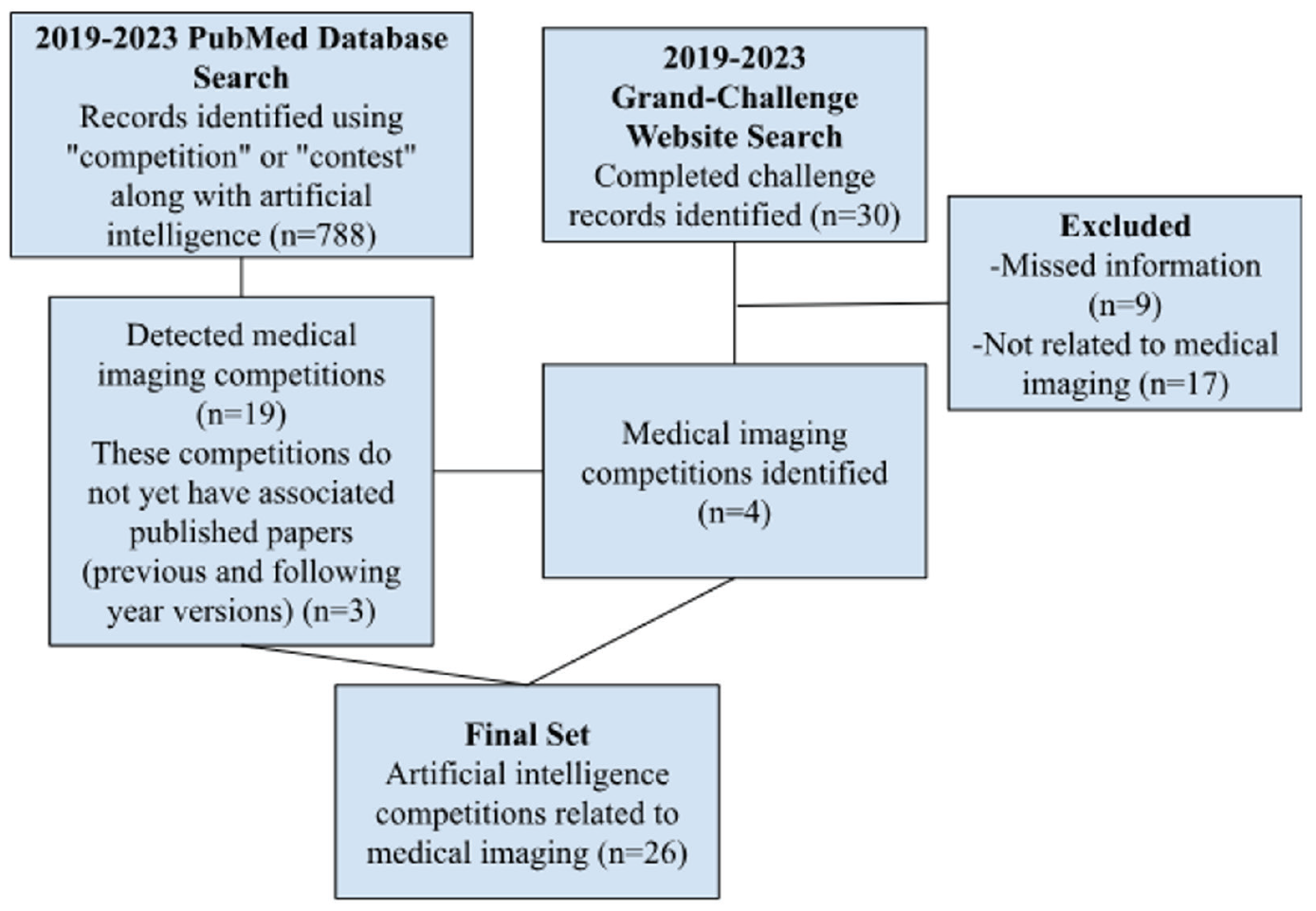
Ethical committee approval and patient consent are not required for this type of article. A search was conducted on the PubMed database using the terms “competition” or “contest” added to the phrase “AI.” The focus was on articles containing result reports of imaging-related competitions between 2019 and 2023. Completed competitions were identified using the “completed” filter on the grand-challenge website. Versions of identified competitions held in previous or subsequent years were also considered. A total of 26 competitions that provided sufficient information and had a substantial impact were included in the review ().
Information recorded for each competition included the competition’s name, year held, imaging modality, target region, search field, dataset source, dataset sample size, dataset accessibility, diversity of contributing institutions, derived academic publications (as of January 2024), citation count according to the Web of Science criteria (as of January 2024), competition location, evaluation criteria, and the number of participating individuals or teams.
Results
This review presents the characteristics of 26 AI and medical imaging-related competitions and datasets between 2017 and 2023 ( and ). These competitions were hosted by organizations such as the Annual Aviation, Space, and Technology Festival (TEKNOFEST), the Radiological Society of North America (RSNA), and the International Conference on Medical Image Computing and Computer-Assisted Intervention (MICCAI), either individually or collectively. Final competitions or winner announcements were held either onsite or online.
Table 1. Features of the competitions and datasets
Competition | Date | Modality | Target structure | Search field | Dataset source | Sample size | Dataset access |
|---|---|---|---|---|---|---|---|
TEKNOFEST 2021 artificial intelligence in health competition (stroke dataset) | 2021 | CT | Brain | Stroke | National Teleradiology System, Türkiye | 877 CT | Open |
TEKNOFEST 2022 artificial intelligence in health competition | 2022 | CT | Abdomen | Abdominal emergencies | National Teleradiology System, Türkiye | 1,517 CT | Open |
TEKNOFEST 2023 artificial intelligence in health competition | 2023 | MG | Breast | Breast cancer | National Teleradiology System, Türkiye | N/A | Restricted |
RSNA pediatric bone age challenge,, | 2017 | X-ray | Hand | Bone age | Stanford University and University of Colorado | 14,236 hand radiographs | Open |
RSNA pneumonia detection challenge, | 2018 | X-ray | Lung | Pneumonia | Public NIH | 26,684 radiographs | Open |
RSNA intracranial hemorrhage detection challenge, | 2019 | CT | Head | Intracranial hemorrhage | Stanford University, Thomas Jefferson University, Unity Health Toronto, Universidade Federal de São Paulo, The American Society of Neuroradiology | 27,861 unique CT | Open |
RSNA pulmonary embolism challenge, | 2020 | CT | Lung | Pulmonary embolism | Multi-institutional | 12,195 CT | Open |
RSNA brain tumor AI challenge | 2021 | MRI | Brain | Brain tumor segmentation/radiogenomic classification | Multinational | 8,000 MRI | Restricted |
RSNA COVID-19 AI detection challenge (SIIM conference on machine intelligence in medical imaging) | 2021 | X-ray | Lung | COVID-19 pneumonia | Multi-database | 10,178 chest radiographs | Open |
RSNA cervical spine fracture AI challenge | 2022 | CT | Neck | Cervical spine fracture | Multinational | 3,112 CT | Open |
RSNA screening mammography breast cancer detection AI challenge | 2023 | MG | Breast | Breast cancer | Mammography screening programs in Australia and the U.S. | 8,000 MG | Open |
RSNA abdominal trauma detection AI challenge | 2023 | CT | Abdomen | Abdominal traumas | Multinational | >4,000 CT | Open |
CHAOS - Combined (CT-MR) healthy abdominal organ segmentation | 2019 | CT/MRI | Abdomen | Abdominal organ segmentation | Dokuz Eylül University | 40 MRI and 40 CT | Open |
Tumor detection, segmentation, and classification challenge on automated 3D breast ultrasound | 2023 | Ultrasound | Breast | Breast cancer | Harbin Medical University Cancer Hospital | 200 ultrasound | Upon request |
KNee OsteoArthritis Prediction Challenge | 2020 | X-ray/MRI | Knee | Knee osteoarthritis | Previous study data | 423 X-ray/MRI | Open |
Surface learning for clinical neuroimaging (MLCN workshop challenge, MICCAI) | 2022 | MRI | Brain | Cortical development | Previous study data | 514 MRI | Upon request |
K2S: from undersampled k-space to automatic segmentation (MICCAI) | 2022 | MRI | Knee | Knee joint degeneration | University of California | 816 MRI | Upon request |
1st Boston neonatal brain injury dataset for hypoxic ischemic encephalopathy lesion segmentation challenge (MICCAI) | 2023 | MRI | Brain | Hypoxic ischemic encephalopathy | Massachusetts General Hospital | 133 MRI | Open |
DBTex Challenge | 2021 | Digital breast tomosynthesis | Breast | Breast cancer | Duke University | 22,032 digital breast tomosynthesis | Open |
COVID-19 lung CT lesion segmentation challenge29 | 2020 | CT | Lung | COVID-19 pneumonia | Previous study data from the Cancer Imaging Archive | 295 CT | Partial |
Kidney tumor segmentation challenge (MICCAI) | 2019 | CT | Kidney | Kidney tumor | University of Minnesota Medical Center | 300 CT | Partial |
Kidney tumor segmentation challenge (MICCAI) | 2021 | CT | Kidney | Kidney tumor/cyst | M Health Fairview or Cleveland Clinic Medical Center | 300 CT | Open |
Kidney tumor segmentation challenge (MICCAI) | 2023 | CT | Kidney | Kidney tumor/cyst | M Health Fairview Medical Center | 599 CT | Open |
French Society of Radiology data challenge,, | 2018 | MRI/CT/Ultrasound | Knee/Kidney/Liver/Breast | Meniscal tear, renal cortex segmentation, lesions of the liver, breast, and thyroid cartilage | Multi-institutional | 5,170 images | N/A |
French Society of Radiology data challenge | 2019 | MRI/CT | Lung/Brain/Muscles | Pulmonary nodule, multiple sclerosis, sarcopenia | Multi-institutional | 4,347 examinations | N/A |
French Society of Radiology data challenge | 2020 | CT/Ultrasound | Breast/Neck/Heart | Breast nodule, neck lymph node, coronary calcium score | Multi-institutional | 2,076 examinations | N/A |
TEKNOFEST, Annual Aviation, Space and Technology Festival; CT, computed tomography; MG, mammography; RSNA, Radiological Society of North America; NIH, National Institutes of Health; AI, artificial intelligence; MRI, magnetic resonance imaging; COVID-19, coronavirus disease 2019; MLCN, Machine Learning in Clinical Neuroimaging; MICCAI, International Conference on Medical Image Computing and Computer-Assisted Intervention.
Table 2. Characteristics of the competitions and publications
Competition | Studies derived from dataset | Citations | Dataset experts | Country | Number of individual participants or teams in the first application | Evaluation criteria |
|---|---|---|---|---|---|---|
TEKNOFEST 2021 artificial intelligence in health competition | 1 | 1 | Multi-institutional radiologists and engineers | Türkiye | 570 participants | F1 score, IoU |
TEKNOFEST 2022 artificial intelligence in health competition | 1 | None | Multi-institutional radiologists and engineers | Türkiye | 213 teams | Mean F1 scores computed across distinct threshold values for IoU |
TEKNOFEST 2023 artificial intelligence in health competition | None | None | Multi-institutional radiologists and engineers | Türkiye | 409 teams | F1 score |
RSNA pediatric bone age challenge | 3 | 271 | Multi-institutional radiologists | U.S. | 260 participants | Mean absolute distance in months |
RSNA pneumonia detection challenge | 2 | 39 | Society for Thoracic radiology members and software | U.S. | 1,400 teams | Mean average precision at different IoU thresholds |
RSNA intracranial hemorrhage detection challenge | 2 | 110 | Multinational via commercial software | U.S. | 1,345 teams | Weighted multi-label logarithmic loss |
RSNA pulmonary embolism detection challenge | 2 | 32 | Society of Thoracic Radiology members | U.S. | 784 teams | Weighted log loss |
RSNA brain tumor AI challenge | 1 | 1 | Multinational | U.S. | 1,555 teams | Dice similarity coefficient, Hausdorff distance (95%), AUC, accuracy, FScore (Beta), and Matthew’s correlation coefficient |
RSNA COVID-19 AI detection challenge | 1 | 6 | Multinational | U.S. | 1,305 teams | Standard PASCAL VOC 2010 mean average precision at IoU >0.5 |
RSNA cervical spine fracture AI challenge | 1 | None | Spine radiology specialists from the American Society of Neuroradiology and the American Society of Spine Radiology | U.S. | 883 teams | Weighted multi-label logarithmic loss |
RSNA screening mammography breast cancer detection AI challenge | None | None | Via commercial software tools | U.S. | 1,687 teams | Probabilistic F1 score |
RSNA abdominal trauma detection AI challenge | None | None | Society of Abdominal Radiology and the American Society of Emergency Radiology members | U.S. | 1,123 teams | Average of the sample weighted log losses from each injury type and an any-injury prediction generated by the metric |
CHAOS - Combined (CT-MR) healthy abdominal organ segmentation | 1 | 195 | Engineers, radiologists, and PhD/MSc/BSc students from Türkiye | Italy | 1,500 participants | Intra- and inter-annotator scores |
Tumor detection, segmentation, and classification challenge on automated 3D breast ultrasound | None | None | Engineer/radiologist from China | Canada (MICCAI 2023) | 503 participants | Dice similarity coefficient, Hausdorff distance, accuracy, AUC, free-response ROC |
KNee OsteoArthritis Prediction Challenge | 1 | 6 | N/A | Netherlands/Online | 20 participants | ROC AUC and balanced accuracy |
Surface learning for clinical neuroimaging (MLCN workshop challenge, MICCAI) | None | None | Engineers and radiologists from the U.K. | Singapore | 91 participants | Mean absolute error |
K2S: from undersampled k-space to automatic segmentation (MICCAI) | 1 | 2 | Multinational engineers and radiologists | Singapore | 87 teams | Dice similarity coefficient |
1st Boston neonatal brain injury dataset for hypoxic ischemic encephalopathy lesion segmentation challenge (MICCAI 2023) | 1 | None | Single-center PhD and MD | Canada | 131 participants | Dice, mean average surface distance, normalized surface distance |
DBTex challenge | 1 | 1 | Multinational engineers and radiologists | U.S. | 8 teams | Free-response ROC |
COVID-19 lung CT lesion segmentation challenge | 1 | 6 | Automated segmentation and confirmation by single-center radiologists | Online | 1,096 teams | Dice coefficient, normalized surface Dice, normalized absolute volume error |
Kidney tumor segmentation challenge (MICCAI 2019) | 3 | 173 | Single radiologist and supervised students | China | 106 teams | Sørensen–Dice coefficient |
Kidney tumor segmentation challenge (MICCAI 2021) | None | None | Multi-institutional radiologists, urologists, and supervised students | France | N/A | Sørensen–Dice, surface Dice |
Kidney tumor segmentation challenge (MICCAI 2023) | None | None | Multi-institutional radiologists, urologists, urologic oncologists, and supervised students | Canada | N/A | Sørensen–Dice, surface Dice |
French Society of Radiology Data Challenge 2018 | 1 | 31 | Multi-institutional radiologists and data scientists | France | 323 participants | Dice score, binary AUC |
French Society of Radiology Data Challenge 2019 | 1 | 18 | Multi-institutional radiologists and data scientists | France | 143 participants | Dice coefficient, AUC, mean square error |
French Society of Radiology Data Challenge 2020 | 1 | 10 | Multi-institutional radiologists and data scientists | France | 39 participants | Concordance index, Dice score, AUROC |
IoU, Intersection over Union; TEKNOFEST, Annual Aviation, Space and Technology Festival; RSNA, Radiological Society of North America; AI, artificial intelligence; AUC, area under the curve; COVID-19, coronavirus disease 2019; VOC, visual object classes; CT, computed tomography; MRI, magnetic resonance imaging; PhD, Doctor of Philosophy; MSc, master of science; BSc, bachelor of science; MICCAI, International Conference on Medical Image Computing and Computer-Assisted Intervention; ROC, receiver operating characteristic; MLCN, Machine Learning in Clinical Neuroimaging; MD, doctor of medicine; AUROC, area under the receiver operating characteristics.
Various imaging modalities, including magnetic resonance imaging, computed tomography, ultrasound, mammography, and digital breast tomosynthesis, were utilized. Competition themes covered different body regions, ranging from the head to the lower limb, with a focus on segmentation, cancer detection, and disease diagnosis. Most competitions used datasets from universities, but some also incorporated data from national teleradiology systems or screening programs. Although the majority of competition datasets were openly accessible, some required approval for access. One competition was conducted exclusively online, whereas others took place both online and onsite.
In the TEKNOFEST competitions, high school students competed in a separate category, distinguishing them from other competitions. Studies derived from these competition datasets were predominantly published in high-impact journals.
Discussion
The current review aims to evaluate AI applications in medical imaging competitions, which are rapidly increasing in today’s medical imaging landscape. High-participation competitions are organized online or onsite in different parts of the world. Collaboration in dataset preparation involves radiologists, clinicians, engineers, and data scientists from different countries and institutions. Studies produced after competitions are published in high-quality journals, and their citation potential is relatively high. Competitions play an effective role in increasing the positive impact and benefits of AI in medical imaging and in generating greater interest in this field.
Organizations such as RSNA, MICCAI, and TEKNOFEST, or online platforms such as the grand-challenge website, host these competitions.,,,,,,,,,,,,,,,,,,,,,,,,,,,, Dataset organization teams have sometimes come together as multinational teams and are generally multi-institutional. AI competitions in medical imaging lead to the establishment of collaborations not only between interdisciplinary teams but also between institutions and countries, both for competition teams and data preparation teams. The robust infrastructure of national teleradiology systems and the strict preservation of imaging data enable the preparation of competition datasets and the generation of results closest to real-world data.
A study examining 2,517 clinical trials related to AI-associated medical devices revealed that research is generally conducted in specific countries at the national level, with studied populations limited to certain regions. In the last few decades, the development of AI technologies in the medical field has turned into a global competition led by China and the United States. Allowing free participation from around the world in AI competitions in the health sector is increasing the momentum of innovation. The expansion of competitions to low-income countries will diversify the data population and facilitate the availability of developed software for the benefit of these countries.
In 2023, a competition format involving young radiologists and radiology trainees was first organized at the European Society of Medical Imaging Informatics Annual Meeting in Pisa, Italy; this marked a milestone in radiologists’ orientation toward AI. Participating in such competitions during the radiology training period can contribute to radiology education in the current era of strong momentum in AI and radiology collaboration.
In a survey conducted among medical students in Canada, it was observed that although radiology specialization was among the top choices, there were widespread concerns about the negative effects of AI on radiologists. Information meetings are suggested to address these concerns. The negative effects of AI on radiology career development have also been noted among US medical students. Public competitions involving medical students will contribute to a more realistic understanding of the relationship between AI and radiology expertise. Encouraging high school students to participate in some competitions strategically promotes AI development and raises social awareness among young individuals who have not yet made career choices. Technology teachers at the high school and even middle school levels can take the lead in encouraging participation in such activities during their training.
Additionally, such competitions can lead to the generation of new study topics on emerging issues and the establishment of new networks, facilitating the creation of start-ups. AI summer schools in medicine for high school students have begun to be established at universities. Ethical dilemmas such as bias risk and data security, along with AI’s potential to assist medical professionals, cannot be overlooked in the realm of AI in healthcare. AI training programs should comprehensively address all these aspects.
The impact of AI-related medical imaging competitions on scientific publication conversion, citation potential, and integration into the literature was investigated. However, another crucial aspect—their clinical application and commercial utilization—lacks sufficient and effective information based on available datasets and publications. To bridge the gap between scientific innovation and clinical practice, it may be beneficial to increase awareness of these competitions among healthcare institutions, AI-related public organizations, and commercial entities while also expanding networking opportunities for competition participants.
Efforts have been made to standardize and enhance transparency in the evaluation of medical imaging competitions, from defining the competition’s mission to dataset preparation methodologies and participant ranking metrics and criteria. However, substantial variations have been observed across these stages. Proper competition design and interpretation can facilitate the validation of AI algorithms and promote their translation into clinical applications. Several factors influence the outcomes of AI-related medical imaging competitions, including the dataset used, the reference annotations determined by annotators, and the scoring system applied for ranking. Quality control at all stages of a competition enhances the validity and reliability of its results. In our review, a comprehensive framework has been established, detailing the design, execution, and outcomes of current AI-related medical imaging competitions.
This review has some limitations. Not all the databases where competitions could be included were examined for all dates. However, by focusing on recent competitions in the most well-known databases and platforms, an attempt was made to minimize selection bias. There are only a few studies in the literature examining competitions related to AI and radiology., However, our review is the first to address the dataset, organization teams, and competition features.
In conclusion, as AI continues to play an increasing role in radiology, competitions related to AI and medical imaging contribute to quality dataset sharing, collaboration among experts, and increased awareness in this field.
Footnotes
Conflict of interest disclosure
The authors declared no conflicts of interest.
References
Recht MP, Dewey M, Dreyer K, et al. Integrating artificial intelligence into the clinical practice of radiology: challenges and recommendations.Eur Radiol.2020;30(6):3576-3584.
https://www.iso.org/obp/ui/en/#iso:std:iso-iec:42001:ed-1:v1:en Accessed: 05 January 2024.
Mulryan P, Ni Chleirigh N, O’Mahony AT, et al. An evaluation of information online on artificial intelligence in medical imaging.Insights Imaging. 2022;13(1):79.
Burnside ES, Grist TM, Lasarev MR, Garrett JW, Morris EA. Artificial intelligence in radiology: a leadership survey.J Am Coll Radiol.2025:S1546-1440(25)00041-00049.
van Hoek J, Huber A, Leichtle A, et al. A survey on the future of radiology among radiologists, medical students and surgeons: students and surgeons tend to be more skeptical about artificial intelligence and radiologists may fear that other disciplines take over.Eur J Radiol.2019;121:108742.
Armato SG 3rd, Drukker K, Hadjiiski L. AI in medical imaging grand challenges: translation from competition to research benefit and patient care.Br J Radiol.2023;96(1150):20221152.
Koç U, Akçapınar Sezer E, Özkaya YA, et al. Artificial intelligence in healthcare competition (TEKNOFEST-2021): stroke data set.Eurasian J Med. 2022;54(3):248-258.
Koç U, Sezer EA, Özkaya YA, et al. Elevating healthcare through artificial intelligence: analyzing the abdominal emergencies data set (TR_ABDOMEN_RAD_EMERGENCY) at TEKNOFEST-2022.Eur Radiol. 2024;34(6):3588-3597.
Artificial intelligence in health competition. Last Accessed: 10.03.2025.
Halabi SS, Prevedello LM, Kalpathy-Cramer J, et al. The RSNA pediatric bone age machine learning challenge.Radiology. 2019;290(2):498-503.
Siegel EL. What can we learn from the RSNA pediatric bone age machine learning challenge?Radiology.2019;290(2):504-505.
Pan I, Thodberg HH, Halabi SS, Kalpathy-Cramer J, Larson DB. improving automated pediatric bone age estimation using ensembles of models from the 2017 RSNA machine learning challenge.Radiol Artif Intell.2019;1(6):e190053.
Pan I, Cadrin-Chênevert A, Cheng PM. Tackling the radiological Society of North America pneumonia detection challenge.AJR Am J Roentgenol. 2019;213(3):568-574.
Chang IY, Huang TY. Deep learning-based classification for lung opacities in chest X-ray radiographs through batch control and sensitivity regulation.Sci Rep. 2022;12(1):17597.
Flanders AE, Prevedello LM, Shih G, et al. Erratum: construction of a machine learning dataset through collaboration: the RSNA 2019 brain CT hemorrhage challenge. Radiol Artif Intell. 2020;2(4):e209002. Erratum for: Radiol Artif Intell.2020;2(3):e190211.
Danilov G, Kotik K, Negreeva A, et al. Classification of intracranial hemorrhage subtypes using deep learning on CT scans.Stud Health Technol Inform.2020;272:370-373.
Colak E, Kitamura FC, Hobbs SB, et al. The RSNA pulmonary embolism CT dataset.Radiol Artif Intell. 2021;3(2):e200254.
Callejas MF, Lin HM, Howard T, et al. Augmentation of the RSNA pulmonary embolism CT dataset with bounding box annotations and anatomic localization of pulmonary emboli.Radiol Artif Intell. 2023;5(3):e230001.
Kim BH, Lee H, Choi KS, et al. Validation of MRI-based models to predict MGMT promoter methylation in gliomas: BraTS 2021 radiogenomics challenge.Cancers (Basel).2022;14(19):4827.
Lakhani P, Mongan J, Singhal C, et al. The 2021 SIIM-FISABIO-RSNA machine learning COVID-19 challenge: annotation and standard exam classification of COVID-19 chest radiographs.J Digit Imaging. 2023;36(1):365-372.
Lin HM, Colak E, Richards T, et al. The RSNA cervical spine fracture CT dataset.Radiol Artif Intell. 2023;5(5):e230034.
https://www.kaggle.com/search?q=rsna Accessed: 08 January 2024.
Kavur AE, Gezer NS, Barış M, et al. CHAOS Challenge - combined (CT-MR) healthy abdominal organ segmentation.Med Image Anal. 2021;69:101950.
Grand challenge. Accessed: 08 Jan 2024.
Hirvasniemi J, Runhaar J, van der Heijden RA, et al. The KNee OsteoArthritis Prediction (KNOAP2020) challenge: an image analysis challenge to predict incident symptomatic radiographic knee osteoarthritis from MRI and X-ray images.Osteoarthritis Cartilage. 2023;31(1):115-125.
Tolpadi AA, Bharadwaj U, Gao KT, et al. K2S challenge: from undersampled k-space to automatic segmentation.Bioengineering (Basel).2023;10(2):267.
Bao R, Song Y, Bates SV, et al. Boston neonatal brain injury dataset for hypoxic ischemic encephalopathy (BONBID-HIE): part I. MRI and manual lesion annotation. bioRxiv [Preprint]. 2023;2023.06.30.546841. Update in:Sci Data. 2025;12(1):53.
Konz N, Buda M, Gu H, et al. A competition, benchmark, code, and data for using artificial intelligence to detect lesions in digital breast tomosynthesis.JAMA Netw Open.2023;6(2):e230524.
Roth HR, Xu Z, Tor-Díez C, et al. Rapid artificial intelligence solutions in a pandemic-The COVID-19-20 lung CT lesion segmentation challenge. Med Image Anal. 2022;82:102605.
Heller N, Isensee F, Maier-Hein KH, et al. The state of the art in kidney and kidney tumor segmentation in contrast-enhanced CT imaging: results of the KiTS19 challenge.Med Image Anal.2021;67:101821.
Sathianathen NJ, Heller N, Tejpaul R, et al. Automatic segmentation of kidneys and kidney tumors: the KiTS19 international challenge.Front Digit Health. 2022;3:797607.
Causey J, Stubblefield J, Qualls J, et al. An ensemble of U-Net models for kidney tumor segmentation with CT images. IEEE/ACM Trans Comput Biol Bioinform. 2022;19(3):1387-1392.
Lassau N, Estienne T, de Vomecourt P, et al. Five simultaneous artificial intelligence data challenges on ultrasound, CT, and MRI.Diagn Interv Imaging.2019;100(4):199-209.
Lassau N, Bousaid I, Chouzenoux E, et al. Three artificial intelligence data challenges based on CT and MRI.Diagn Interv Imaging. 2020;101(12):783-788.
Lassau N, Bousaid I, Chouzenoux E, et al. Three artificial intelligence data challenges based on CT and ultrasound. Diagn Interv Imaging.2021;102(11):669-674.
Serra-Burriel M, Miquel, Locher L, Kerstin N. Vokinger KN. Development pipeline and geographic representation of trials for artificial intelligence/machine learning–enabled medical devices (2010 to 2023). NEJM AI. 2023;1(1).
Akinci D’Antonoli T, Huisman M. EuSoMII 2023 Highlights and the EU AI Act. Accessed: 10 Jan 2024.
Gong B, Nugent JP, Guest W, Parker W, Chang PJ, Khosa F, Nicolaou S. Influence of artificial intelligence on Canadian Medical Students’ preference for radiology specialty: anational survey study. Acad Radiol. 2019;26(4):566-577.
Reeder K, Lee H. Impact of artificial intelligence on US medical students’ choice of radiology.Clin Imaging.2022;81:67-71.
Center for Artifical Intelligence in Medicine & Imaging. Summer Research Internship. Accessed: 10 Jan 2024.
Korkmaz S. Artificial intelligence in healthcare: a revolutionary ally or an ethical dilemma?Balkan Med J.2024;41(2):87-88.
Maier-Hein L, Reinke A, Kozubek M, et al. BIAS: transparent reporting of biomedical image analysis challenges.Med Image Anal. 2020;66:101796.
Reinke A, Tizabi MD, Eisenmann M, Maier-Hein L. Common pitfalls and recommendations for grand challenges in medical artificial intelligence.Eur Urol Focus. 2021;7(4):710-712.
Maier-Hein L, Eisenmann M, Reinke A, et al. Why rankings of biomedical image analysis competitions should be interpreted with care.Nat Commun. ;9(1):5217. Erratum in:Nat Commun. 2019;10(1):588.
Wagner DT, Tilmans L, Peng K, et al. Artificial intelligence in neuroradiology: a review of current topics and competition challenges.Diagnostics (Basel).2023;13(16):2670.